Kelli kriteriýasy we ruletka
Kelli kriteriýasy artykmaçlygy bolan oýunça näçe stawka goýmalydygyny aýdýar. Ruletka üçin ol aýdyň jogap berýär: hiç zat.

Kelli stawkasy = artykmaçlyk / koeffisiýent. Otrisatel artykmaçlykda formula otrisatel paý berýär, bu bolsa stawka goýmaň diýmekdir. Kriteriýa egrilik oýunçylarynyň stawkalaryny näme üçin şeýle möçberde goýandygyna we beýleki hemmeleriň näme üçin býujete görä möçber saýlamalydygyna düşünmek üçin henizem peýdaly.
Kriteriýa
John Kelly (1956) asked how a gambler with a known edge should size bets to maximize long-run growth of the bankrollpulOýun gaznasyOýun üçin aýrylan umumy pul. Oýun gaznasyny dolandyrmak onuň näçesini her stawkada we her seansda töwekgelçilige salmalydygyny kesgitlemekdir.Dolulygyna okaň →. The answer, for a bet paying b to 1 with win probabilitymatematikaÄhtimallykNetijäniň mümkinçiligi, 0-dan 1-e ýa-da 0%-den 100%-e çenli. Bir san: 1/37 = 2,70%.Dolulygyna okaň → p and loss probability q = 1 − p, is to stake the fraction f* = (bp − q) / b of the bankroll. Positive f* means bet that fraction; zero or negative means do not bet. Kelly worked at Bell Labs, and his paper, “A new interpretation of information rate”, set the problem in Claude Shannon’s theory of information: a gambler who gets tips over a noisy line, at fair odds, can grow the bankroll at best at the rate the line carries information. This is a growth objective under a probability model, not a promise to finish ahead after a particular number of bets. A spending limit, finite deadline or payoutpulTölegUtýan stawkanyň gaýtaryp berýän puly, yzyna gaýtarylýan stawkanyň üstüne “X-e 1” görnüşinde aýdylýar.Dolulygyna okaň → cap changes the decision problem.
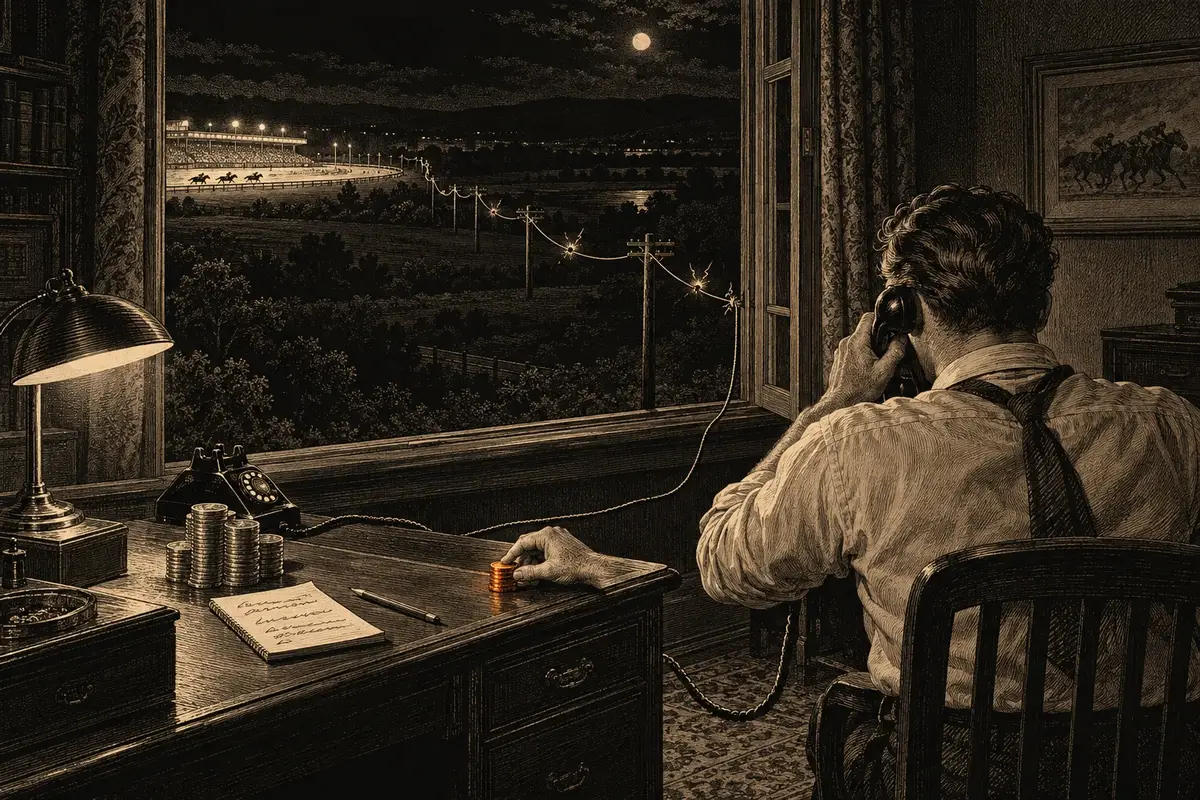
Ruletkada Kelli boýunça stawka
For redstawkaGyzyl18 gyzyl sana deň tölegli stawka. Fransuzça: rouge.Dolulygyna okaň →: b = 1, p = 18/37, q = 19/37; f* = (18/37 − 19/37)/1 = −1/37. For a straight upstawkaBir sana stawkaÝeke san, töleg 35:1.Dolulygyna okaň →: b = 35, p = 1/37, q = 36/37; f* = (35/37 − 36/37)/35 = −1/1295. Every standard bet gives a negative Kelly fraction, because every bet has a negative edge, and the growth-optimal stake is zero. Kelly betting on roulette is a formal way of saying what the house-edge page says: no positive stake maximizes expected logarithmic growth when the bet has negative expectation. A particular session can still end in profit. La partagedüzgünLa partageFransuz düzgüni: nol düşende deň tölegli stawkanyň ýarysy yzyna gaýtarylýar. Şol stawkalarda kazinonyň artykmaçlygyny iki esse azaldyp, 1,35%-e çenli peseldýär.Dolulygyna okaň → needs a separate three-outcome calculation: a win, a full loss or a half-loss on zeroçarhNolHiç bir deň tölegli, onikilik ýa-da sütün stawkasynyň ýapmaýan ýeke ýaşyl öýjügi; kazinonyň artykmaçlygynyň çeşmesi. Başga atlary: ýeke nol, 0.Dolulygyna okaň →. Its expected log growth also falls as the stake increases from zero.
Kelli nirede ulanyldy
Suppose a pocketenjamÖýjükRotordaky 37 sany belgilenen bölümiň biri. Başga atlary: ýuwa, çukur.Dolulygyna okaň → really has a stable, known probability of 1 in 30 and pays 35 to 1. The Kelly fraction is 0.57%: about $57 from a $10,000 bankroll. Under independent spinsmatematikaGaraşsyz aýlawlarHer aýlawyň öňki taryha garamazdan şol bir ähtimallyklary bar. Bu saýtdaky her bir hasaplamanyň esasy.Dolulygyna okaň → and exact fractional staking, the geometric growth factor over 1,000 spins is about 1.7. Expected bankroll grows faster because rare large wins pull up the average. These are model calculations, not evidence that any named historical player used Kelly or achieved this result.
Adaty we ortaça
The gap between the typical bankroll and the average one is wide. Take a pocket that hits 1 time in 25, a hypothetical edge of 44% per unitpulBirlikUlgamyň ýa-da oýunçynyň işleýän esasy stawkasy. Progressiýalar islendik stolda ulanyp bolar ýaly birliklerde beýan edilýär.Dolulygyna okaň → staked. Kelly stakes 1.26% of the bankroll on it. After 1,000 spins the typical bankroll has grown about 11.5 times, while the average, pulled up by a few very lucky runs, has grown about 249 times. Betting more than Kelly raises the average and lowers the typical result: at twice the Kelly stake the typical bankroll only doubles, and by two and a half times the Kelly stake it shrinks, although every bet still carries a 44% edge. In this example, half-Kelly retains about 78% of the expected log growth. This fraction depends on the probabilities and payout.
Artykmaçlyk diňe çaklama bolanda
Kelly uses the true probabilities, but a player usually has only estimates. Selecting the busiest pocket from a past record creates a selection problem: even a fair wheel has a busiest pocket. Its observed rate can overstate its future probability. Choosing the stake from that same record compounds the error. An independent follow-up sample helps test a proposed bias (see How to Detect Roulette Wheel Bias). Reducing the calculated fraction reduces exposure, but cannot turn a false edge into a real one.
Artykmaçlygy bolan adamlar
Haghani and Dewey (2016) studied 61 participants given $25 and 30 minutes to bet on a simulated coin with a disclosed 60% chance of heads. The payout cap was $250; its value was revealed when a proposed winning bet would reach it. Their reported 21% success category included balances of at least $200, while the 28% “bust” category meant less than $2, not necessarily zero. Eighteen participants bet their entire balance on one flip. The uncapped Kelly fraction is 20%, but the cap and deadline change the optimization problem. The experiment illustrates how stake choices matter even with a known advantage; it does not establish one best strategy for every objective.
Onuň ýerine näme ulanmaly
Artykmaçlyk bolmasa, stawkanyň möçberi ösüş meselesi däl-de, býujet meselesi: stawka = sagatlyk býujetden we stoluň depgininden çykarylan, bir aýlawa harçlamaga taýyn mukdaryňyz (Ruletkada oýun gaznasyny dolandyrmak sahypasy). Kelliniň adaty oýunça goşandy onuň jogabynyň aýdyňlygy: nol. Noldan ýokary goýýan her zadyňyz oýnamagyň bahasy, ony haýsydyr bir formula däl-de, siz özüňiz saýlaýarsyňyz.
Paýly Kelli we “pul dolandyryşy” barada bellik
Betting a fixed percentage of the current bankroll is proportional staking: the stake rises after wins and falls after losses. Flat bettingstrategiýaHemişelik stawkaHer aýlawda şol bir mukdary goýmak. Her progressiýanyň deňeşdirilýän esasy nusgasy.Dolulygyna okaň → instead keeps the cash stake fixed. Neither creates an edge on ordinary roulette. With infinitely divisible stakes and a fraction below 100%, proportional staking never reaches exactly zero in finitely many losses, but the balance can become arbitrarily small. Real table minimums can prevent further play much sooner. The growth-optimal fraction remains zero.
Formula
Soraglar
Only when the actual probabilities, payouts and conditions give a credible positive advantage. Standard bets on an unbiased wheel have no such advantage.
Using half the calculated fraction reduces exposure to errors in the estimated edge. The familiar three-quarters-growth rule is an approximation for small advantages, not a universal identity. It does not protect against an edge that does not exist.
Ýok. Kelli artykmaçlyk bar bolanda ösüşi optimallaşdyrýar. Oýun gaznasyny dolandyrmak artykmaçlyk ýok bolanda harajatlary gözegçilikde saklaýar.
Matematika bilen güýmenje
Ilki özüňiz synap görüň. Her çözgüt ýapyk; taýýar bolanyňyzda açyň.
Suppose a hypothetical bet on one number has a known 44% edge under standard payoutspulTölegUtýan stawkanyň gaýtaryp berýän puly, yzyna gaýtarylýan stawkanyň üstüne “X-e 1” görnüşinde aýdylýar.Dolulygyna okaň → and independent spinsmatematikaGaraşsyz aýlawlarHer aýlawyň öňki taryha garamazdan şol bir ähtimallyklary bar. Bu saýtdaky her bir hasaplamanyň esasy.Dolulygyna okaň →. Kelly gives a 1.26% bankrollpulOýun gaznasyOýun üçin aýrylan umumy pul. Oýun gaznasyny dolandyrmak onuň näçesini her stawkada we her seansda töwekgelçilige salmalydygyny kesgitlemekdir.Dolulygyna okaň → fraction. What if the same 44% edge came on one bet spread over five neighboring numbers?
Çözgüdi görkez
Jogap Onda Kelli oýun gaznasynyň 7,1%-ini maslahat berýär we oýun gaznasy alty esse diýen ýaly çalt ösýär: 1 000 stawkada takmynan 1,25 million esse, takmynan 11,5 essä garşy.
A straight upstawkaBir sana stawkaÝeke san, töleg 35:1.Dolulygyna okaň → with a 44% edge wins with chance 0.04, since 36 × 0.04 = 1.44. Kelly’s stake is the edge divided by the odds: 0.44/35 = 1.26%. The typical growth per bet is 0.04 × ln(1 + 35 × 0.0126) + 0.96 × ln(1 − 0.0126) ≈ 0.00244, so 1,000 bets multiply the bankroll by about e^2.44 ≈ 11.5.
Spread one stake over five numbers and the bet wins with chance 0.20 and pays 36/5 for 1, that is 6.2 to 1: still a 44% edge, since 0.2 × 7.2 = 1.44. Kelly’s stake becomes 0.44/6.2 = 7.10%, and the growth per bet 0.01404, about 5.75 times as much. Over 1,000 bets that is e^14.04, about 1.25 million.
The edge is the same; the swings are smaller. A bet that wins one time in five has a larger growth-optimal fraction in this model, although losses can still reduce the bankroll severely. This comparison assumes the same known edge for both bets; actual predictions need independent evidence.
Assume two numbers are adjacent on the betting layoutenjamMeýdançaStoldaky çap edilen stawka tory. Başga atlary: stol, mata, örtük.Dolulygyna okaň → and each has a stable, known probabilitymatematikaÄhtimallykNetijäniň mümkinçiligi, 0-dan 1-e ýa-da 0%-den 100%-e çenli. Bir san: 1/37 = 2,70%.Dolulygyna okaň → of 1 in 25 on independent spins. Compare a splitstawkaSplitIki goňşy san, töleg 17:1.Dolulygyna okaň → between them at 17 to 1 with equal straight-up stakes on the two numbers. How much does Kelly say, and how fast does the bankroll grow compared with one such pocketenjamÖýjükRotordaky 37 sany belgilenen bölümiň biri. Başga atlary: ýuwa, çukur.Dolulygyna okaň →?
Çözgüdi görkez
Jogap Tapawudy ýok: splite oýun gaznasynyň 2,59%-i ýa-da her sana 1,29%. Adaty oýun gaznasy 1 000 aýlawda takmynan 155 esse ösýär, bir öýjük bilen 11,5 essä garşy.
The split wins with probability 2/25 = 0.08 and pays 17 to 1, so it returns 18 × 0.08 = 1.44 per unitpulBirlikUlgamyň ýa-da oýunçynyň işleýän esasy stawkasy. Progressiýalar islendik stolda ulanyp bolar ýaly birliklerde beýan edilýär.Dolulygyna okaň → staked: an edge of 44%, the same as one biased pocket. Kelly’s stake is the edge divided by the odds: 0.44/17 = 2.59%.
Two straight-up bets of 1.29% each give exactly the same results. When either number comes up, one chippulFişkaKesgitli mukdary aňladýan, stawka etmek üçin meýdança goýulýan nyşan. Başga ady: check.Dolulygyna okaň → wins 35 to 1 and the other is lost, a net of 34 × 1.29% = 44% of the bankroll, as the split pays; when neither does, both are lost.
The growth per spin is 0.00505, against 0.00244 for one pocket, so over 1,000 spins the typical bankroll grows e^5.046 ≈ 155 times rather than e^2.44 ≈ 11.5 times. The geometric growth factor is larger because the combined bet wins more often at the same 44% edge. It is a model result, not a guaranteed bankroll.
Degişme üçin
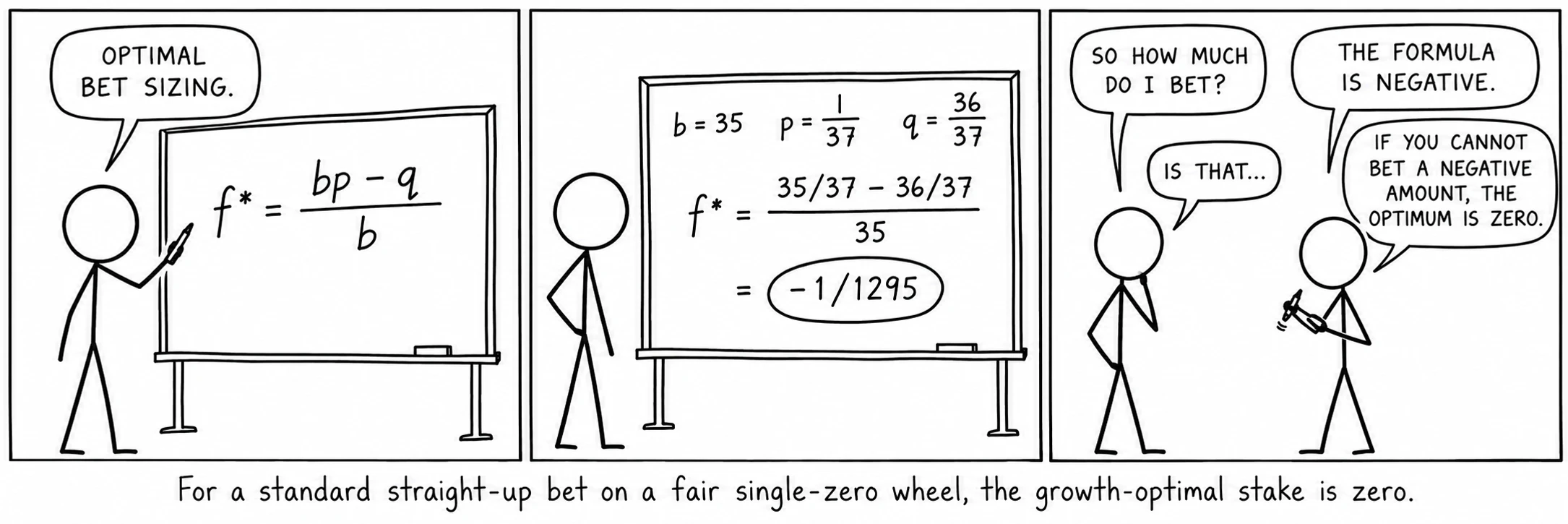
Ruletkada ösüş üçin optimal stawka eýýäm hemmä belli san.
Çeşmeler
- Kelly, J. L. “A new interpretation of information rate.”
- Breiman, L. “Optimal gambling systems for favorable games.”
- Thorp, E. O. “Optimal gambling systems for favorable games.”
- Thorp, E. O. The Mathematics of Gambling.
- Epstein, R. A. The Theory of Gambling and Statistical Logic, 2nd ed.
- Taylor, D. G. Games, Gambling, and Probability: An Introduction to Mathematics, 2nd ed.
- Ethier, S. N. The Doctrine of Chances: Probabilistic Aspects of Gambling.
- Haghani, V. & Dewey, R. “Rational decision-making under uncertainty: observed betting patterns on a biased coin.”